Enhanced trajectory reconstruction from sparse and noisy GPS data: A progressive chunked transformer approach

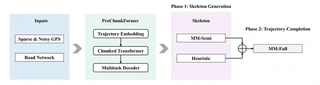 ProChunkFormer overview. Phase 1 (Skeleton Generation): the sparse, noisy GPS trajectory and the road network are encoded and decoded into a semi-high-frequency skeleton, MM-Semi. Phase 2 (Trajectory Completion): conditioned on that skeleton and a heuristic shortest-path estimate, the remaining trajectory is split into chunks and reconstructed in parallel; concatenating the chunks gives the final reconstructed trajectory, MM-Full.
GPS traces collected in the wild are sparse and noisy — long gaps between fixes are the norm, not the exception. Reconstructing a coherent, road-consistent trajectory from such data matters for mobility analysis, transportation planning, and navigation, but the long output sequences involved make it computationally expensive, and autoregressive models tend to accumulate error step by step over a long reconstruction.
ProChunkFormer tackles this with a two-phase, divide-and-conquer strategy instead of decoding the full trajectory one point at a time:
- Phase 1 — Skeleton generation. The sparse, low-frequency GPS input and the road network are encoded and decoded into an intermediate, semi-high-frequency “skeleton” of the trajectory (
MM-Semi) that already follows the road network. - Phase 2 — Trajectory completion. Conditioned on that skeleton — and optionally on a heuristic shortest-path estimate (
Heuristic) computed between each pair of consecutive skeleton points — the remaining trajectory is divided into chunks and reconstructed in parallel with self-attention, rather than autoregressively. Concatenating all the reconstructed chunks gives the final, complete trajectory (MM-Full).
Self-attention is quadratic in the length of the sequence it looks at, but standard autoregressive decoding still ends up cubic in the length of the whole trajectory, because each of its output steps has to attend over an ever-growing context. ProChunkFormer avoids this by sizing each attention pass to a chunk rather than the full trajectory and generating chunks in parallel; the paper’s complexity analysis shows this cuts decoding time by roughly the cube of the number of chunks used, compared with standard autoregressive decoding. On an open-source taxi trajectory dataset, this lets ProChunkFormer match the accuracy of autoregressive transformer baselines while running faster — 13.9%, 16.5%, and 20.7% faster at sampling intervals of 60, 120, and 240 seconds, respectively — with the largest accuracy gains showing up on the hardest cases: long sampling intervals of up to 240 seconds, where it improves accuracy by 23.1%, F1 score by 18.6%, mean absolute error by 22.3%, and road-network error by 25.1% over a standard transformer baseline.
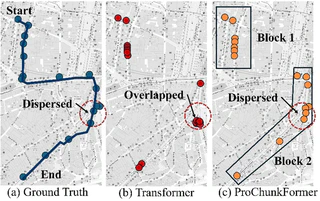
Adding heuristic guidance — using the shortest path between consecutive skeleton points to help condition each chunk’s reconstruction — speeds up convergence during training and improves accuracy and error metrics in most configurations, though the paper reports a few cases (for example, accuracy at a 120-second sampling interval) where it produces a small decline instead.
