Unified Model of Sediment Transport Threshold and Rate Across Weak and Intense Subaqueous Bedload, Windblown Sand, and Windblown Snow

Grains get pushed along a riverbed, blown across a desert dune, or carried over a snowfield by very different physical processes — yet in each case, a grain that isn’t fully suspended in the fluid moves the same basic way: it hops, rolls, or slides along the bed in a sequence of collisions. This is called nonsuspended sediment transport (NST), and it shapes sedimentary landscapes on Earth and other planetary bodies alike. In reality NST is messy: turbulence, an uneven bed surface, and grain-to-grain variability make individual grain trajectories highly erratic. This paper asks whether, despite that mess, one single deterministic model can still predict both when transport starts (the threshold) and how much material moves once it does (the rate) — across fluvial settings (grains driven by a stream of liquid) and aeolian settings (grains driven by wind) at once.
The model’s key idea is to represent the entire population of grains — including ones that mostly roll or slide rather than hop — by a single, repeating (periodic) saltation trajectory: a grain leaves the bed, follows a ballistic-like path shaped by the mean turbulent flow profile above the bed, and comes back down, where an empirical “rebound law” (fit to grain-bed collision experiments and simulations) sets its average rebound velocity as a function of how it hit the bed. The transport threshold is then defined as the weakest flow for which such a self-sustaining periodic trajectory can still exist, with an extra criterion checking whether a grain has enough energy to roll itself out of the most stable pockets of the bed surface.
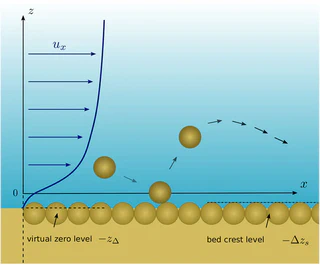
What makes the result notable is that none of the model’s parameters were tuned to the data it is then tested against — they were fixed beforehand from independent experiments and simulations (grain-bed rebound measurements, earlier discrete-element-method simulations of transport, and separate studies of bed yielding). With those parameters locked in, the model reproduces laboratory measurements and field data of both the transport threshold and the transport rate to within about a factor of two, across density ratios between grain and fluid spanning roughly 2.65 (mineral grains in water) up to around 2000 (mineral grains or snow in air) — that is, across subaqueous bedload, windblown sand, and windblown snow together.
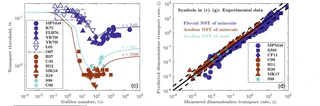
A striking side finding concerns cohesion. Windblown sand and snow grains are known to stick together via cohesive bonds, yet the model captures their behavior without ever explicitly representing cohesion. This lines up with independent DEM simulations showing that equilibrium aeolian transport is nearly unaffected by how strong those cohesive bonds are — a fairly counterintuitive result that this model helps explain: in the model’s picture, cohesion only matters while a grain is in contact with the bed, and for grains that are mostly saltating (as opposed to rolling), those contacts are so brief that cohesion barely gets a chance to act. The model also yields a simple, physically grounded way to tell apart “bedload” (where a significant fraction of grains roll or slide in sustained contact with the bed) from “saltation” (where that fraction is negligible) — consistent with an independent criterion from the authors’ earlier work — and it further separates viscous from turbulent transport regimes based on how the grain’s hop height compares to the flow’s viscous sublayer thickness.
