Motion Prediction & Reconstruction
Understand movement from trajectory data.
Transformer-based trajectory reconstruction and systematic analysis of forecasting inputs.

PhD candidate · KAIST
Cho Chun Shik Graduate School of Mobility
AI Research & Engineering
My research spans spatiotemporal AI, generative modeling, and representation learning. My published work covers trajectory reconstruction, motion prediction analysis, and road-network representations using large language models and graph neural networks. I am currently developing research systems for controllable traffic simulation and adaptive sensing, with applications in autonomous driving and urban mobility.
I am a Ph.D. candidate at KAIST, advised by Prof. Inhi Kim in the TUPA Lab. I received my M.S. from Zhejiang University and previously worked as a software engineer at Meituan.
Research Areas
My work combines sequence modeling, generative models, and representation learning, with published studies and ongoing system projects.
Understand movement from trajectory data.
Transformer-based trajectory reconstruction and systematic analysis of forecasting inputs.
Generate motion in interacting traffic.
Current work on route-conditioned traffic generation, joint fine-tuning, and closed-loop evaluation.
Learn semantic representations of urban networks.
Language models and graph neural networks for road representations and cross-taxonomy label alignment.

A model-agnostic protocol that decomposes trajectory forecasting inputs into Past, Current, and Prior to quantify each one's standalone and marginal contribution.

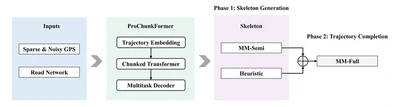
ProChunkFormer, a progressive chunked transformer that reconstructs trajectories from sparse, noisy GPS data, matching an autoregressive transformer's accuracy while running …
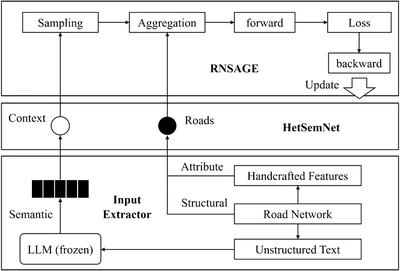
A heterogeneous graph framework (HetSemNet) that fuses LLM-derived POI semantics with road topology, generalizing across cities on road type classification.
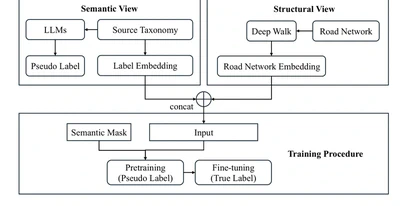
LLM prompt-based pseudo-labels plus road-network structural embeddings align labels across transportation taxonomies, even with only 1% labeled data.
From methods to systems
Putting research into practice through controllable traffic simulation and an adaptive sensing workspace.
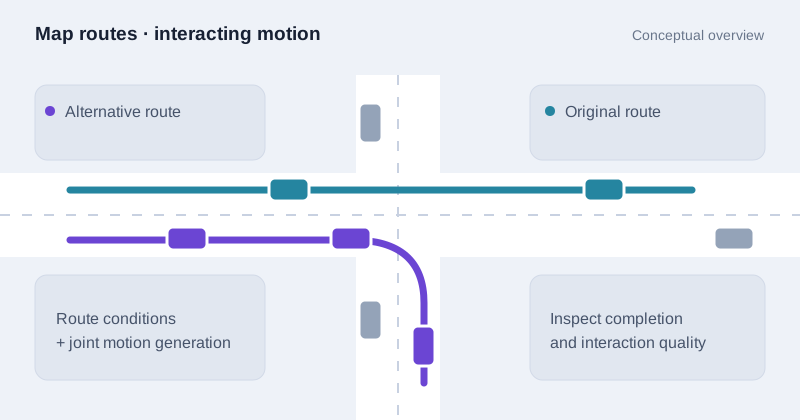
Ongoing research
Learning to follow map routes in interacting traffic, with intent-aware task allocation and closed-loop evaluation.
Explore project : Route-Conditioned Traffic Simulation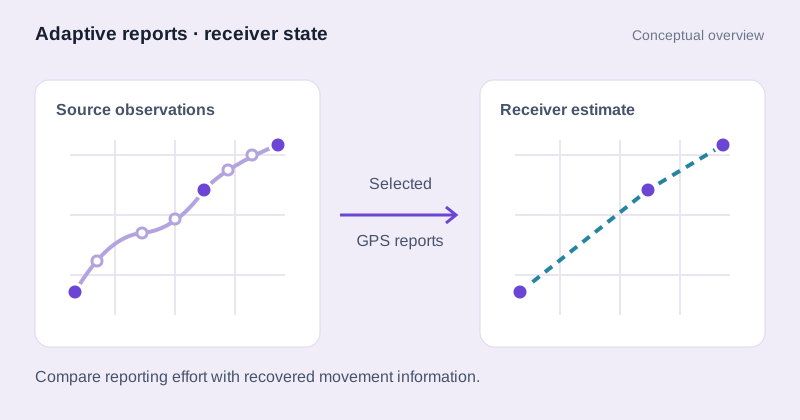
Working research prototype
A replay-based web prototype for adaptive GPS reporting, receiver-state estimation, and historical trajectory reconstruction.
Explore project : Autonomous Traffic Sensor Web (ATSW)I welcome research and engineering conversations on spatiotemporal AI, generative modeling, and representation learning.